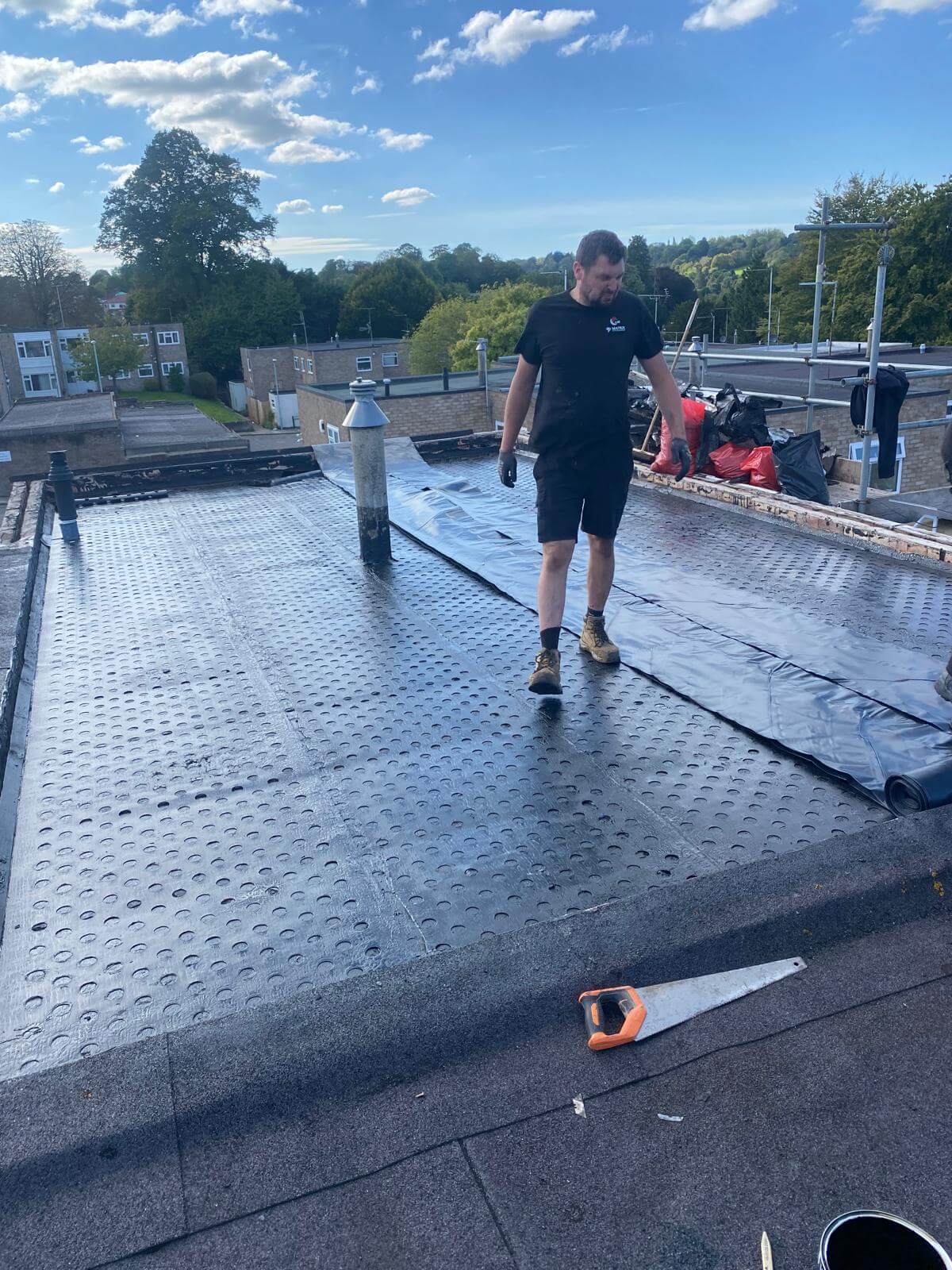
Bristol has one of the highest concentrations of flat-roofed rear extensions in England.
The wave of post-war kitchen and bathroom extensions built across Bedminster, Southville, Kingswood, Filton, and Horfield during the 1950s through to the 1980s left tens of thousands of properties with flat roofs in torch-on felt that is now 40 to 55 years old — well past its practical design life. Most of these roofs are leaking, or about to.
The problem isn't just the age. It's that flat roof failure is silent. Felt that's cracking and blistering on the surface may have been letting water through to the timber deck below for months before a damp patch appears on the kitchen ceiling. By the time the homeowner notices, the roof deck is often saturated and in some cases structurally compromised.
At TD Roofing Contractors we've been assessing and recovering flat roofs across Bristol for over 20 years. We don't patch roofs that need replacing and we don't recommend replacement when a targeted repair would hold. The free 4K drone survey — plus close inspection at deck level — gives us the evidence to tell you honestly which situation you're in before you spend a penny.
The right system depends on three things — the size of the roof, whether it needs to carry foot traffic, and your budget. Here's an honest breakdown.
EPDM Rubber — Our Recommended System for Most Bristol Properties
The correct choice for the majority of rear extensions, garage roofs, and flat roof sections across Bristol's Victorian and post-war housing stock.
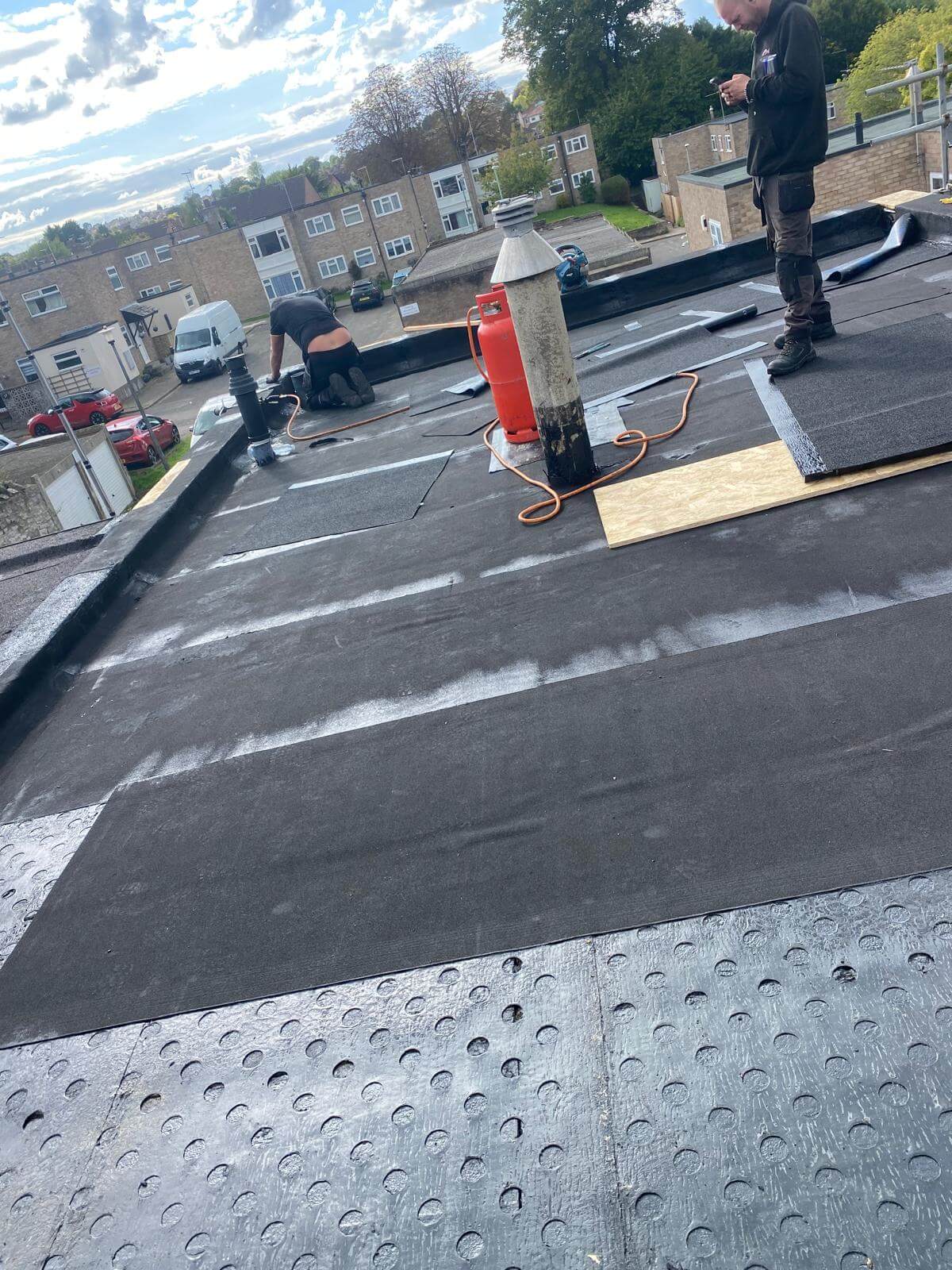
EPDM is a single-ply rubber membrane installed as one continuous sheet — eliminating the seam failures that cause most felt roof leaks. It's cold-applied with no naked flame near timber, carries a 20-year material warranty, and has a practical lifespan of 30 to 50 years.
Typical cost: £80 to £110 per m² — a standard garage or rear extension usually comes in at £1,200 to £2,500.
GRP Fibreglass — For Roofs That Need to Be Walked On
The correct choice for balconies, roof terraces, and any flat roof section with regular foot access.
GRP is applied as a liquid resin that cures into a single rigid shell — genuinely seamless, extremely hard-wearing, and the only residential flat roof system suitable for regular foot traffic. Available in a range of topcoat colours including Anthracite Grey.
Typical cost: £90 to £150 per m² — typically £1,400 to £3,500 for a balcony or roof terrace.
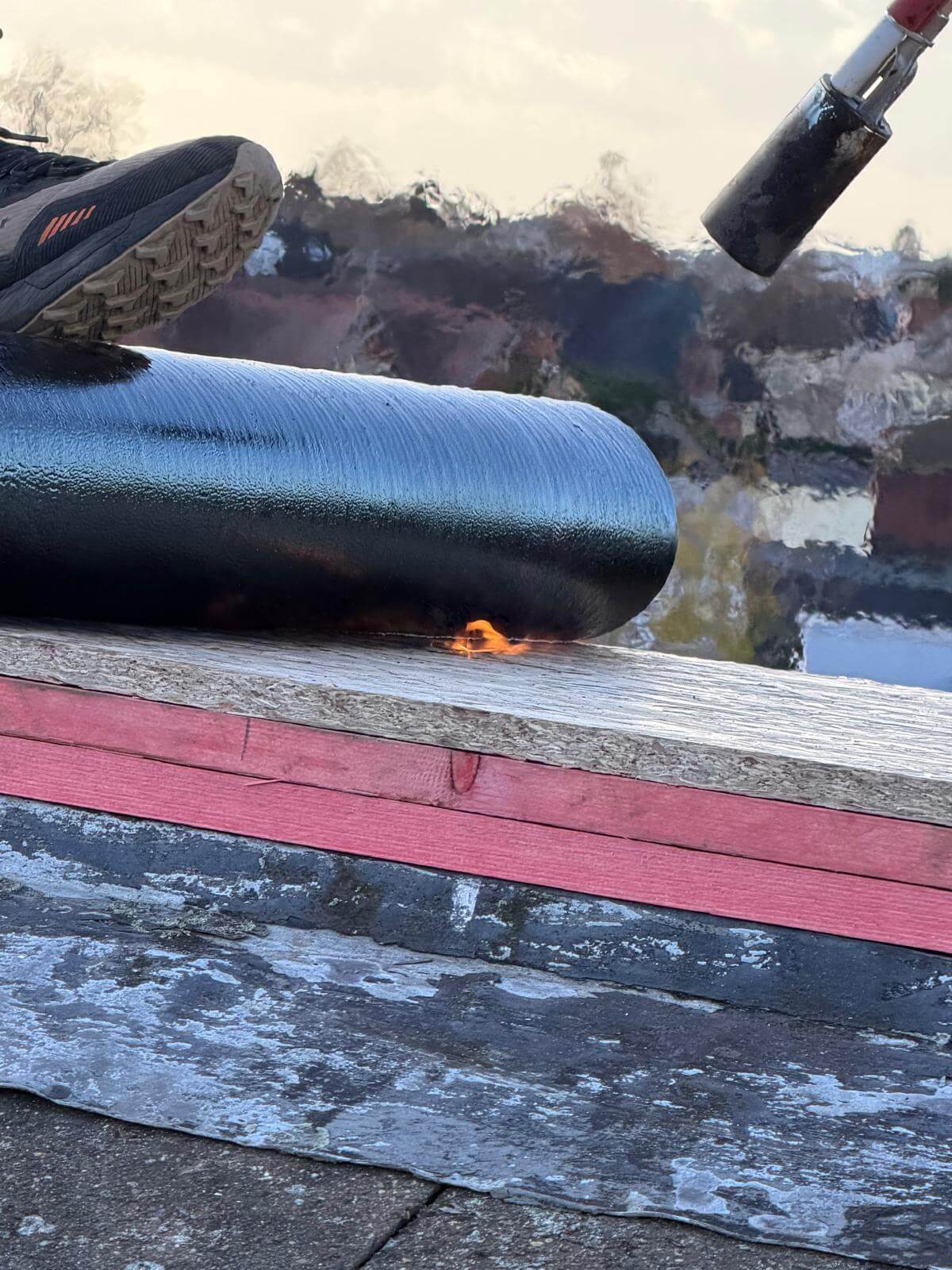
Torch-on Felt — A Cost-Effective Option for Outbuildings
A legitimate choice for garages and secondary structures where budget is the primary consideration. Modern multi-layer torch-on felt performs well and carries a design life of 15 to 20 years.
We're honest about the trade-off — EPDM lasts twice as long for a modest additional cost. On a rear extension you'll be living with for 30 years, EPDM is the better long-term decision. On a garden outbuilding where budget is the priority, torch-on felt is a practical and sound choice.
Typical cost: £50 to £80 per m² — typically £750 to £1,600 for a standard garage roof.
TD Roofing Contractors provides rapid-response roofing services throughout the entire BS postcode area. With over 20 years in the city, we understand the specific challenges of Bristol’s architecture—from the exposed heights of Clifton to the historic terraces of Southville.
North Bristol: Clifton (BS8), Redland & Cotham (BS6), Westbury-on-Trym (BS9), and Bishopston (BS7).
South Bristol: Bedminster & Southville (BS3), Totterdown (BS4), and Knowle (BS4).
East & West Bristol: St George (BS5), Fishponds (BS16), Kingswood (BS15), and Shirehampton (BS11).
Greater Bristol: Filton, Bradley Stoke, Patchway, Portishead, and Keynsham.
Standing water on a flat roof is not normal — it's a drainage failure.
A correctly specified flat roof has a minimum fall of 1:80 — roughly 12mm drop per metre — directing water toward the outlet. When this fall is insufficient, lost through deck movement, or was never correctly specified in the original installation, water pools at the lowest point and sits.
Standing water accelerates every other flat roof failure. It adds dead weight to the deck, increases UV degradation of the membrane at the waterline, and when it eventually freezes in winter, the expansion forces open any existing membrane weakness.
We correct drainage falls using tapered insulation overlays — installed over the existing deck where it's sound enough to retain — or as part of a full strip-and-replace where the deck and membrane both need renewal. Every flat roof we install leaves site with a confirmed minimum drainage fall.
The most common failure point on Bristol's ageing torch-on felt roofs.
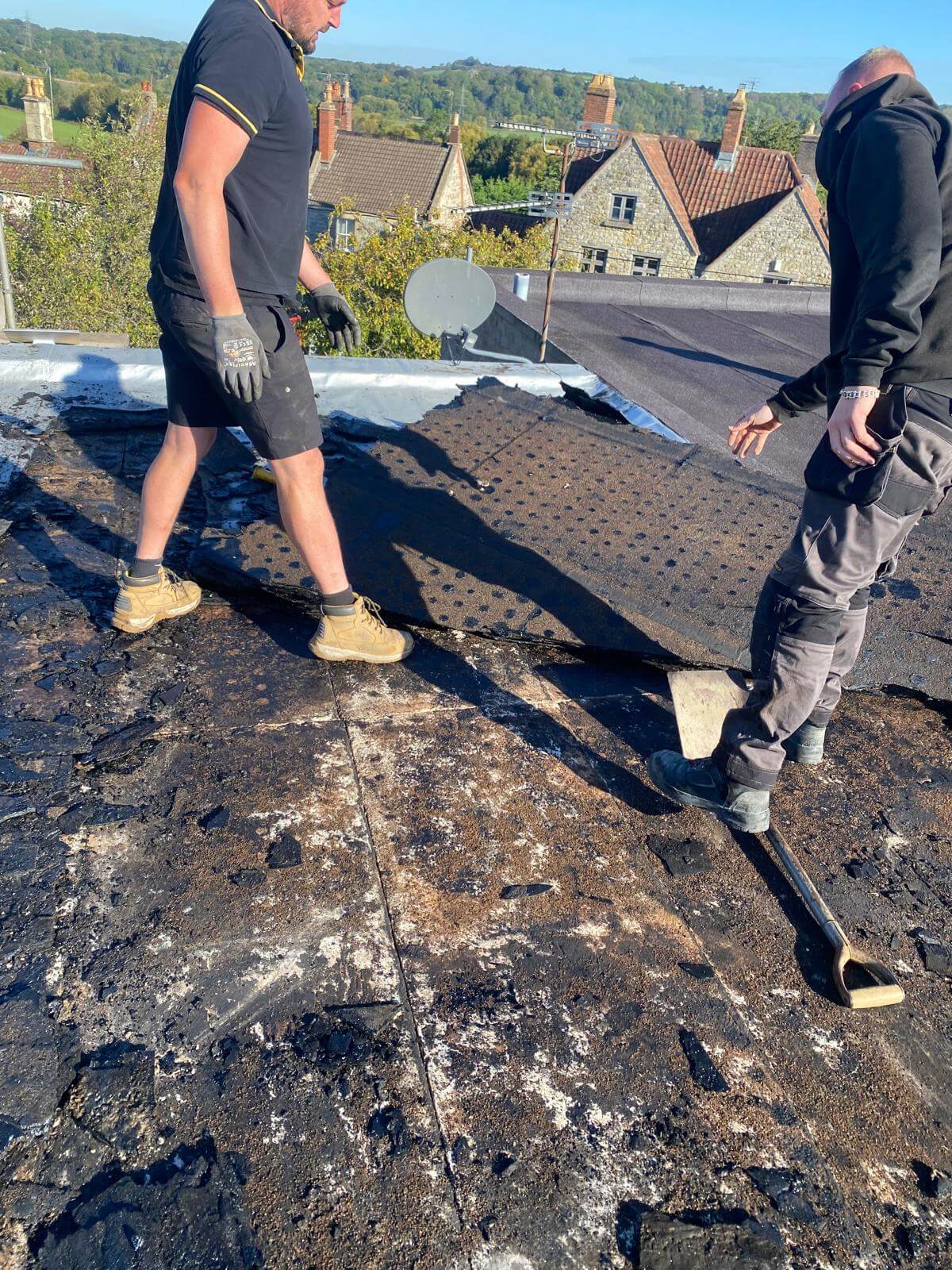
Traditional felt roofs are installed in overlapping sheets — each overlap is a potential seam, and each seam is a potential failure point. As the felt ages and becomes brittle, these seams open under thermal movement. A felt roof that's 30 years old may have dozens of seam failures across its surface, some actively admitting water and some weeks away from doing so.
Patching individual seams on a felt roof of this age is a false economy. For every seam you seal, three more are at the same stage of deterioration. The correct response is a full membrane replacement in a modern seamless system — EPDM rubber or GRP fibreglass — that eliminates the seam failure point entirely. We'll tell you honestly after the survey whether a patch repair is a legitimate option or a short-term delay of the inevitable.
Surface blistering and cracking on bitumen felt is a late indicator, not an early warning.
Blistering occurs when moisture trapped beneath the felt membrane expands under heat, pushing the surface layer up into domed bubbles. Cracking occurs when the bitumen binder becomes brittle under UV exposure and loses its flexibility. Both indicate a membrane that has moved past its serviceable life.
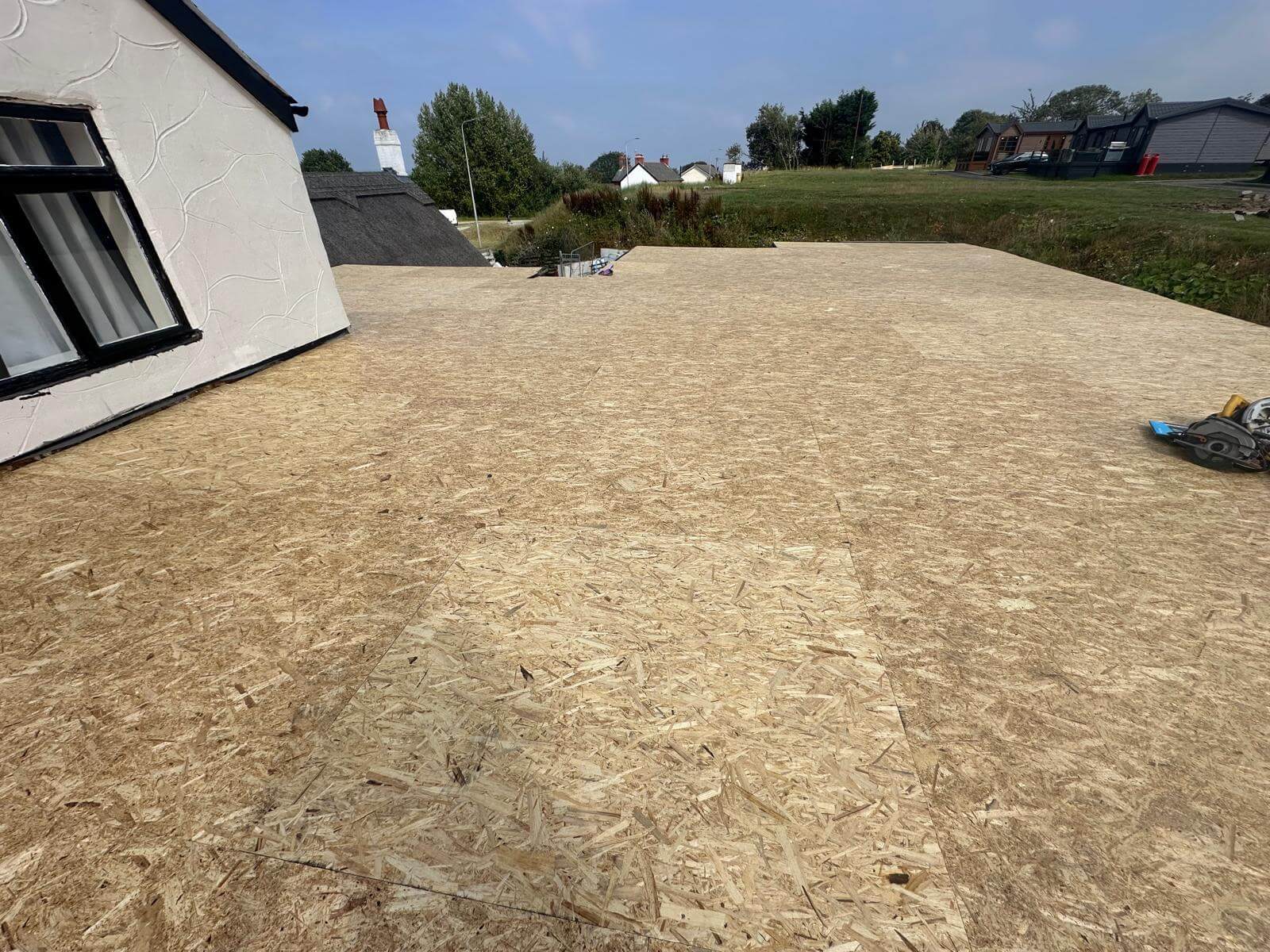
The important point is what's happening below the surface. A blistering felt membrane that's been in this condition for one to two Bristol winters has almost certainly allowed moisture into the roof deck beneath it. The deck condition — whether the plywood or timber boarding is still structurally sound, or whether it's wet, soft, and needs replacing — is what determines the full scope of the repair. We assess deck condition as part of every flat roof survey before quoting.
Damp on an internal ceiling below a flat roof is rarely where the leak actually is.
Water enters a flat roof at one point and travels — along the deck, through insulation layers, and through timber — before dripping through at the lowest available point. The damp patch on your kitchen ceiling may be two metres from the actual membrane failure. Patching directly above the damp patch without a proper roof survey will almost never solve a flat roof leak.
The most common failure points we find on Bristol's flat-roofed extensions are:
We map the full roof surface during the drone survey and close inspection before identifying the failure point — not the symptom point.
Minor repairs usually range from £150 to £450. A full replacement typically costs between £80 and £120 per square metre, depending on whether you choose EPDM or GRP. We provide fixed-price quotes with no hidden extras.
Minor targeted repairs — a single seam re-seal, an outlet collar replacement, or a parapet upstand re-bond — typically cost £150 to £450 depending on the extent of the failure and access requirements.
Full membrane replacement costs vary by system and roof size:
Deck replacement — where the existing timber boarding or plywood is wet or structurally compromised — adds £30 to £60 per m² to the base membrane cost and is always quoted separately after deck condition is confirmed.
We can perform emergency "make-safe" repairs in wet weather to stop water entering your home. However, permanent bonding (for EPDM or GRP) requires a dry deck to ensure a perfect, lifelong seal.
Most single garage or kitchen extension roofs can be fully stripped, insulated, and re-covered in 1 to 2 days.
Almost certainly because the repair addressed the symptom rather than the cause. Flat roof leaks almost never originate where they appear on the interior ceiling — water enters at one point and tracks through the deck structure before finding a path through. If a previous contractor patched directly above the damp patch without surveying the full roof surface, they repaired the wrong location. Our survey maps the full membrane before we identify the failure point.
Soft spots when you press on the membrane surface, visible sagging between joists, or a spongy feel underfoot on an accessible flat roof all indicate deck saturation. We assess deck condition as a standard element of every flat roof survey — pressing at intervals across the surface and, where access allows, lifting a small section of membrane at the edge to inspect the deck beneath. If the deck is wet, we tell you before we quote.
In some cases yes — where the existing felt is a single layer, the deck beneath is confirmed dry, and the existing surface is clean and well-adhered. In most cases on Bristol's older flat roofs we recommend a full strip — because installing EPDM over a failing felt layer traps moisture between the two membranes and causes premature adhesion failure of the new system. We assess this honestly on every survey rather than defaulting to one answer.


Flat roofs are not evenly distributed across Bristol. They're concentrated in specific areas and on specific property types — and understanding this helps explain why certain parts of the city are seeing a surge in flat roof replacement enquiries right now.
Post-war rear extensions — Bedminster, Southville, Horfield, Kingswood, Filton
The single largest category of flat roof work across Bristol. Victorian and Edwardian terraces gained flat-roofed rear kitchen and bathroom extensions throughout the 1950s, 60s, and 70s. The torch-on felt on most of these is now 40 to 55 years old — 20 to 40 years past its design life. These are the roofs generating the majority of Bristol flat roof replacement enquiries in 2026.
Integral garages — Filton, Bradley Stoke, Kingswood, Staple Hill, Horfield
Post-war and council-built properties across north and east Bristol almost universally have flat-roofed integral or adjacent garages. Original felt from the 1960s and 70s is now comprehensively past its practical life. Many have been leaking into the garage space for years without the homeowner connecting it to the roof.
Butterfly valley extensions — Totterdown, Southville, Montpelier
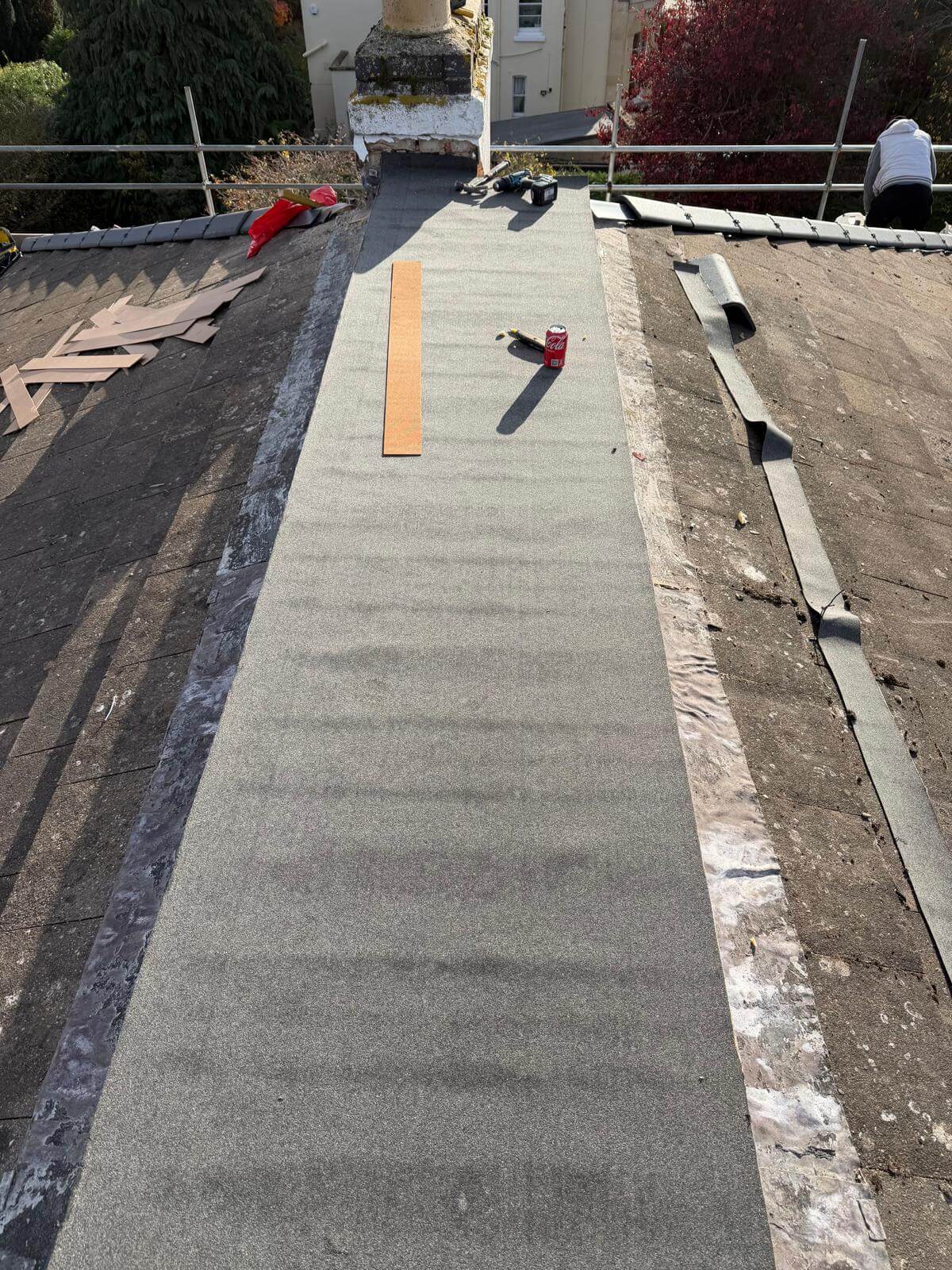
The flat section of a butterfly valley roof — where the two slopes meet at an internal gutter — is effectively a flat roof element requiring the same maintenance as any other flat roof membrane. Failed butterfly valley linings are the most commonly misdiagnosed flat roof problem in Bristol — homeowners are told they have a chimney leak or a slate issue when the actual failure is the valley membrane.
Modern extensions — across all Bristol postcodes
The 1990s and 2000s saw a wave of rear and side extensions across Bristol's housing stock, many with flat-roofed sections in early EPDM or modified bitumen systems. These systems are now 20 to 30 years old and approaching the end of their first life cycle. Early EPDM installed before current cold-applied adhesive technology was widely adopted can show adhesion failures and seam opening.
Most flat roof failures in Bristol don't announce themselves dramatically. They develop quietly — a membrane blistering through the summer, a seam opening through the first autumn rain, water tracking through a deck that's been getting wetter for six months — until a damp patch appears on the ceiling and the damage is already done.
The earlier a failing flat roof is assessed and recovered, the lower the total cost — because a membrane recovered before the deck is saturated costs significantly less than a membrane recovery plus full deck replacement after prolonged water ingress.
Free 4K drone survey, written quote with full deck condition assessment, no obligation.

We don’t just "patch leaks." At TD Roofing, we're your Bristol Roofers that deliver engineered solutions specifically designed to withstand the high-velocity winds of the Severn Estuary. Every project is executed strictly to BS 5534 standards, ensuring your home has the maximum wind resistance and structural longevity required for the Bristol climate.
TD Roofing Contractors are your local roofing contractors in Bristol, providing 20+ years of expert service. From emergency roof repairs to new slate installations, we cover all BS postcodes with quality and integrity.
Copyright © 2026 TD Roofing Contractors LTD. All Rights Reserved.
Web Design by Tradesman Marketing Experts