
The Victorian terrace rows running along and off Staple Hill High Street and around Page Park represent some of the oldest residential stock in BS16. These properties — built between 1875 and 1910 — have original cast iron half-round guttering that in many cases hasn't received any meaningful maintenance attention in decades.
Cast iron guttering that's regularly painted and joint-sealed lasts indefinitely. Cast iron that's been left unpainted on the interior channel — where moisture sits between rainfalls — corrodes from the inside out. The exterior paintwork tells you nothing about the interior condition. A section that looks acceptable from the pavement can have through-corrosion at the base of the channel, allowing water to drip from the lowest point of the run directly onto the wall beneath.
The Seymour Road and Forest Road Victorian terrace rows in particular show the pattern we see consistently — guttering that's been patched rather than systematically maintained, fascia boards rotting behind overflowing sections, and downpipes blocked at the shoe from years of accumulated debris. By the time the internal wall damp appears, the guttering failure has typically been developing for three to five years.


The Full Run, Not Just the Visible Section
The most common limitation of a pavement gutter assessment is that it only sees the front elevation. Rear elevation guttering on Staple Hill's terrace rows fails at the same rate as the front — often faster because it's in shade, retains moisture longer, and is less likely to be noticed when it starts overflowing. We check every elevation during the survey.
Downpipe Condition from Outlet to Ground
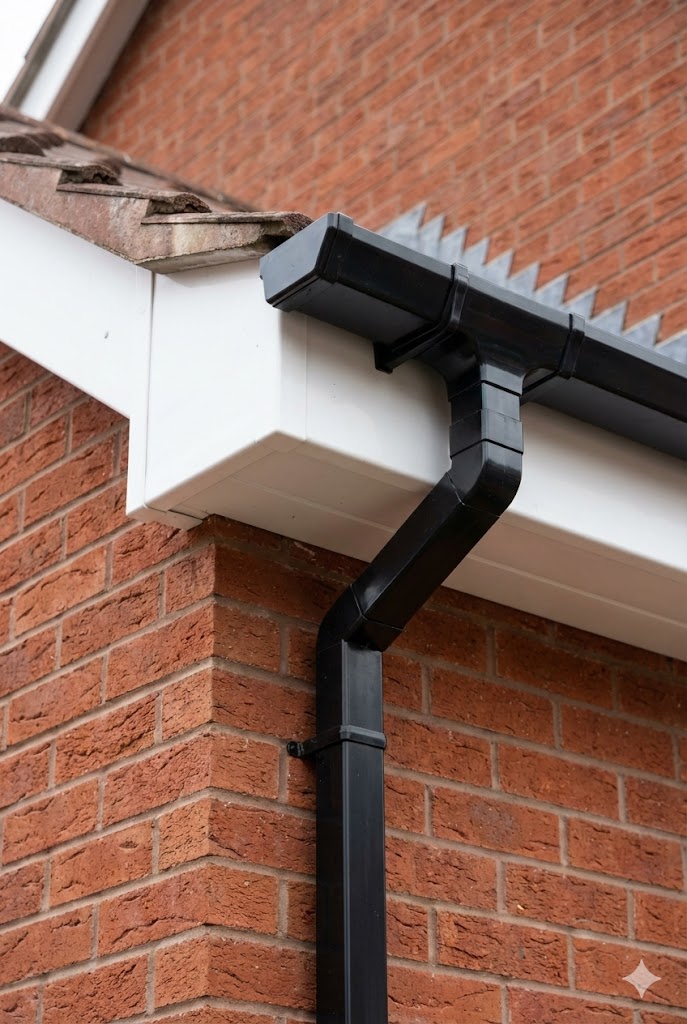
The downpipe shoe at ground level is the most common blockage point on both cast iron and uPVC systems across BS16. We trace every downpipe from gutter connection to drain outlet and confirm the full drainage path is clear before signing off any gutter repair.
Fascia Board Condition
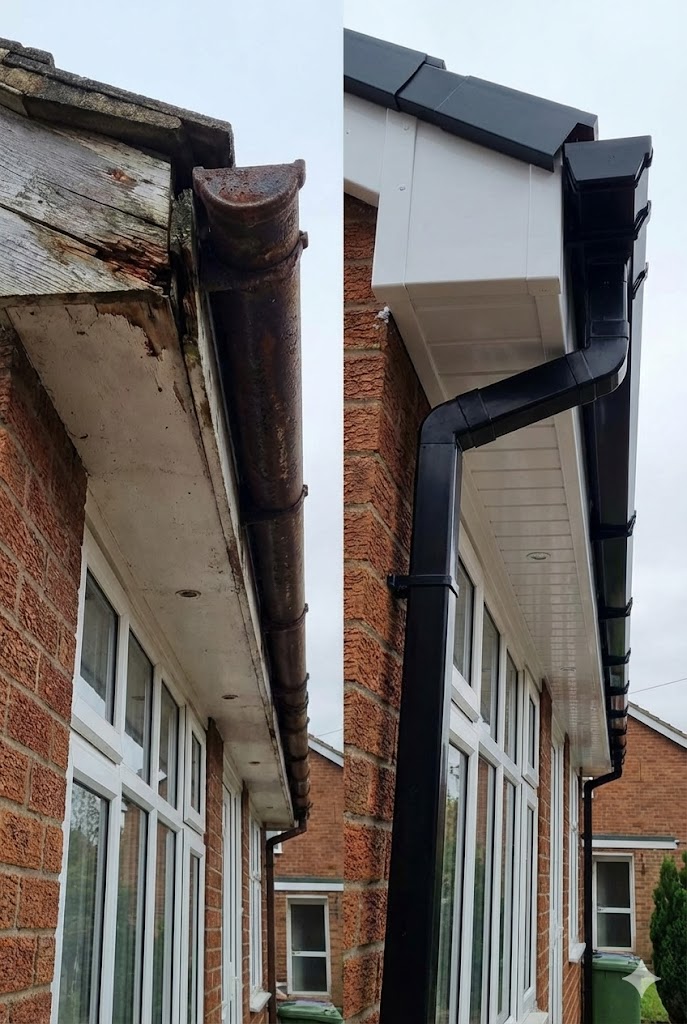
Rotten fascia behind the gutterline is so consistent on Staple Hill's Victorian and post-war properties that we treat it as an expected finding rather than a surprise. We check every section of fascia behind the guttering during the survey. Fitting new guttering to rotten timber is money wasted within 12 months.
The Junction Between Main Roof and Rear Extension
Many Staple Hill terraces have flat-roofed rear extensions — and the drainage junction between the extension and the main rear elevation gutter is a consistent failure point. Water from the extension drains — or should drain — into the main gutter run. When this junction is blocked or failed, the extension roof backs up and overflows against the rear wall. We check every extension drainage junction as a standard survey element.
Move away from the Page Park corridor toward the wider residential streets of Staple Hill — Soundwell Road, Broad Street, and the quieter roads feeding off them — and the housing character shifts to interwar and post-war semis and terraces. Most of these properties had their guttering replaced or installed in uPVC during the 1970s and 1980s. That uPVC is now 40 to 50 years old.
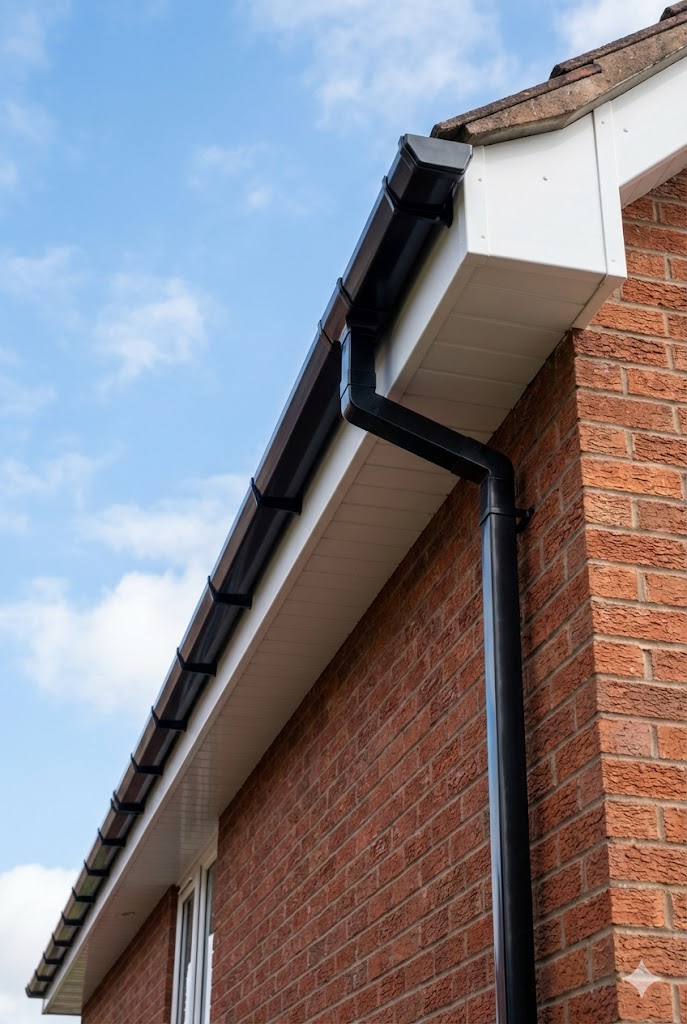
The failure pattern on ageing uPVC systems is fundamentally different to cast iron failure. Cast iron fails section by section, at joints and at corroded points. Ageing uPVC fails at multiple points simultaneously — every union clip in the run has the same age and the same degraded rubber seal, every bracket has corroded at the same fixing point, and the plastic itself has become brittle enough that it cracks under UV exposure at any point under stress.
When a 1970s uPVC system on a Staple Hill post-war semi starts failing, it isn't one joint that needs re-sealing. It's typically three or four joints that have failed already and another two or three that will fail before the winter is out. The honest recommendation at this stage — and it's one we make clearly after the survey — is full replacement rather than a series of repairs that each cost something and collectively cost more than a replacement would have.
Many Staple Hill guttering calls come to us after a specific heavy rainfall event — a prolonged Atlantic low-pressure system or a sharp summer thunderstorm that puts more water through the guttering system in two hours than it normally sees in a week. The event itself didn't cause the failure. It revealed a failure that had been developing gradually and quietly.
The blocked downpipe shoe that backs up in a storm was accumulating debris over months. The cast iron joint that overflows heavily was weeping gently in ordinary rain. The fascia that's now visibly wet was absorbing moisture from a failing bracket for the past two years.
We treat the storm-revealed failure as the prompt to investigate the full system — not just the point where the water became obvious. The full survey almost always finds that the visible failure is one of several that the system has been developing across multiple locations simultaneously.

Overflowing cast iron, failing uPVC system, rear extension drainage concern, or a post-storm problem you want assessed properly? Call Thomas. Free full-property survey, written quote, no obligation.

We don’t just "patch leaks." At TD Roofing we deliver engineered solutions specifically designed to withstand the high-velocity winds of the Severn Estuary. Every project is executed strictly to BS 5534 standards, ensuring your home has the maximum wind resistance and structural longevity required for the Bristol climate.


TD Roofing Contractors are your local roofing contractors in Bristol, providing 20+ years of expert service. From emergency roof repairs to new slate installations, we cover all BS postcodes with quality and integrity.
Copyright © 2026 TD Roofing Contractors LTD. All Rights Reserved.
Web Design by Tradesman Marketing Experts